


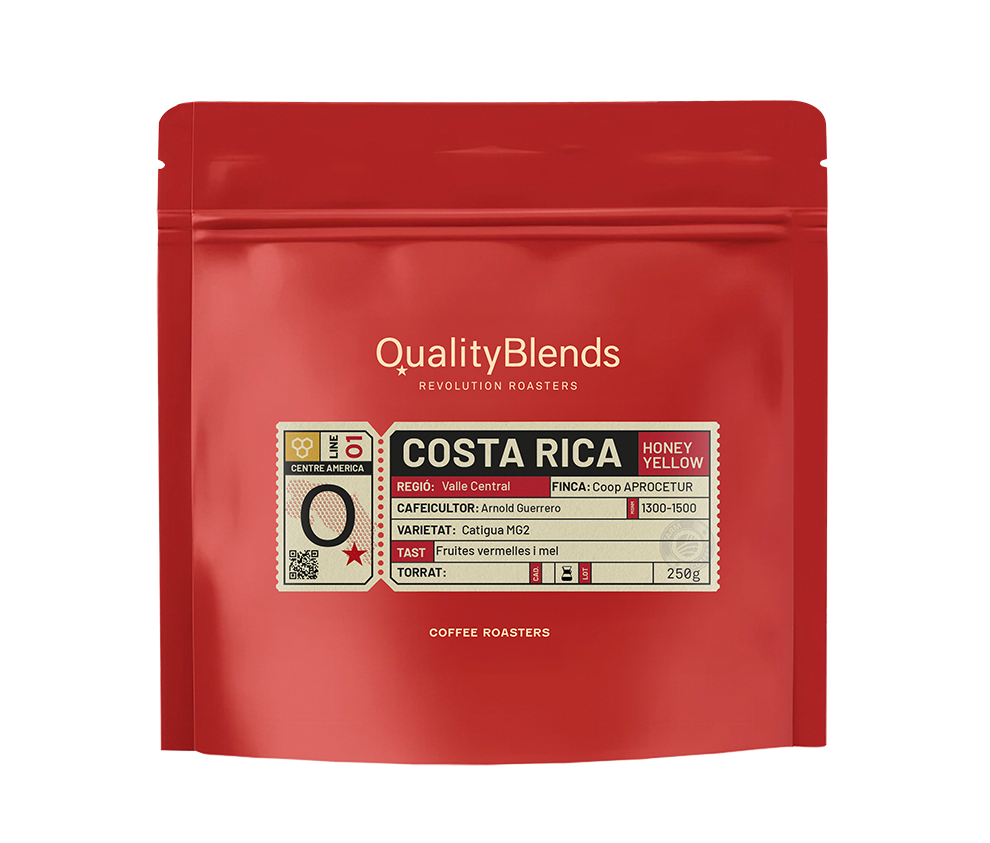
Guanábana, llet, fruites vermelles i mel
Costa Rica – Turrubares Aprocetu Catigua – Yellow Honey
Costa Rica – Turrubares Aprocetu Catigua – Yellow Honey
- Process: Washed
- Variety: Catigua MG2
- Height: 1300 - 1500
- Coffee Cultivator: Arnold Guerrero
- Finca: Apply
- Notes: Soursop, milk, red fruits and honey
Couldn't load pickup availability
Share

About this coffee
The history of the APROCETU association is linked to the efforts of small producers. It currently has 36 coffee farmers, although it was founded with 17, the result of the needs of the communities of San Rafael, El Pital, El Caite and La Potenciana. At that time, many residents were abandoning the countryside and, with it, coffee cultivation. Today, thanks to the project and teamwork, families have resumed harvesting and have managed to strengthen their community. Don Arnoldo is one of the founders. In 2002, together with 16 other producers, he promoted the creation of the APROCETU cooperative. In 2009, they managed to benefit jointly from a community harvest for the first time, marking a before and after for the association. Don Arnoldo's history goes back much further. He was one of the first to plant coffee in the Turrubares area, in the 1970s. Together with their father, they began to cultivate and distribute coffee in the region, while neighbors like Abel Ramírez contributed to coffee farming by planting varieties such as Caturra and Catuaí on their farms. At that time, the only transport available was horses and carts, which made it very difficult to market coffee. In 1985, the neighbors decided to organize themselves and created two coffee receptions, which allowed them to improve the harvest and give more visibility to their product. Since then, the coffees in the area began to be distinguished by their high quality in the cup.
However, in the 2000s, the coffee price crisis caused a strong migration of families and the abandonment of many coffee farms. Faced with this situation, Don Arnoldo again promoted the project, convinced that a community profit center would not only help reactivate coffee farming, but also generate employment and support families in the region.